
A story from Fortune rudely assaulted my news feed recently. The title of it is big and scary:
WHOAHH! Everything I know is a LIE! I NEED to find another job! NOW!!!
Haha. No.
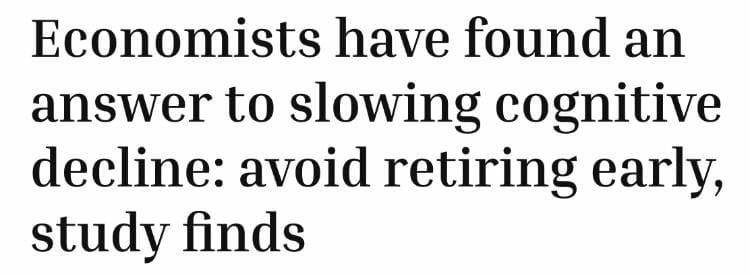
The article referenced a paper by the National Bureau of Economic Research which had more scary words:
Correlational evidence suggests that leaving the workforce before retirement age could accelerate the pace of cognitive decline.
My knee-jerk reaction when I see a headline like this is to reject it. Of course I would. I retired early and yap about it all the time. See this blog. I’m biased! But after I calmed down, I realized that the article has some truth to it. But it’s complicated…
Retirement Killed My Dad
My dad didn’t retire voluntarily. We was an electrician and when the Great Recession hit, he was laid off, never to go back to work again.
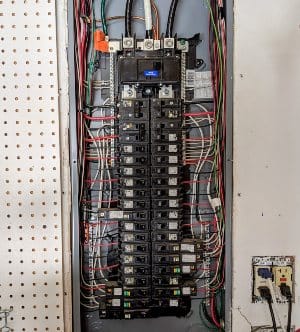
He loved his work and took great pride in it. Setting up a new electrical panel in a previous home of mine was one of the last electrical things he did. Note the meticulous wiring:
Losing his job left him listless. He didn’t have much of a friend network and little else going on. He battled depression and gained at least 50 pounds. His blood pressure went sky-high and eventually killed him when his aorta ruptured. I think there’s a good chance he would still be alive if he hadn’t lost his job. He was lost with without it.
My dad is an extreme case of what the Fortune article discussed. He declined violently.
But here is where it gets complicated:
Is the problem really early retirement?
Hint: No.
The problem is YOU.
The world is fascinating and vast with infinite shit to keep you busy for 1,000 lifetimes. If you engage with it, your brain and muscles will not turn to mush. However, if you just sit around in front of the *&^@ing TV, of course you’re going to decline! DUH!!!
It’s all about consumption versus creation. Creating and doing is what keeps us alive and vibrant. But you have to work at it.
So in a backward sort of way, the article actually makes a case for early retirement:
- The longer you stay at a job, the more your life gets intertwined with it. If you’re not careful, your purpose, friends, and meaning will become tightly coupled to your job. At that point, it’s not just a job, it’s your life. Quit or get fired and you lose it all.
- The longer you stay at a job, the less of an opportunity you have to build a life outside of it. Retire at 65 and it’s going to be more difficult to make new friends, travel, start new hobbies, and get fit. Retire at 45 and you’ll quickly learn that you have to figure the rest out for yourself. It took me a while to catch a wave and after over 9 years of early retirement, I’m still not completely OK with sitting still. Pretty much ever. But I’m a lot less wound up than I was when I had a job.
Again, the problem isn’t early retirement; it’s building a life in retirement. And the best way to do that is to either:
- Work hard at building a good life while you’re still at your job. (Not easy if you have an intense career and a family.)
- Quit early to give yourself more time.
I’m A Better Example Of Myself Post-Formal Job
The article didn’t talk about all of the good things that can happen should you do retirement right. Here is what happened to me.
Body
When I was working, I sat at a desk all day. I was slightly overweight and my blood pressure reflected it. Almost 10 years after retirement, I’m in far better shape than I was when I was working. A friend of mine who met me around 2016 described me as an amorphous blob. He was right. The photo on the left is me shortly before I left work. Ugggh. The other two are present-day me. The proof is in the pudding. Or lack of it.
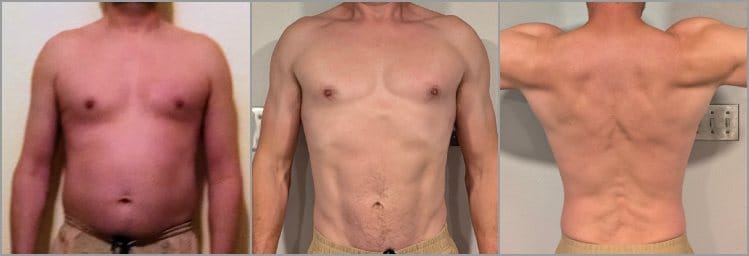
I’m not going to win Mr. Universe or even Mr. Longmont any time soon. Or ever. But I’ve decreased my chances of dying of a cardiovascular malady like my dad.
Mind
My cognitive abilities are probably at least as good as when I stopped formal work. Instead of doing the same thing every day, I’ve had almost 10 years of challenges including:
- Built a complex deck and pergola
- Finished a basement
- Built a shed
- Installed solar panels on two of my homes
- Remodeled countless kitchens and bathrooms
- Building a home! Loads of planning and design work. But also:
- Designed and installed an ERV system
- Designed and installed a hydronic floor heat system
- For my next act, I’m working on a comic. I’m also picking up the guitar and piano again.

By doing all of that work, I’ve learned a ton too. I’m far more resilient now than I was when I left work.
And I’ve also worked on my mental health. I used to spend way too much time in the past, feeling sorry for myself over some of my circumstances.
It’s hard to let it go.
It’s even harder to forgive.
It’s even harder to give yourself grace.
I was at war with myself. I went for help and I’m in a better place now.
One other strange and unexpected effect is that I feel like my true authentic self. In my case, I’ve reverted to a junior high school kid in a lot of ways. To the extreme embarrassment of my kids, I’ll run full speed behind a shopping cart in parking lots and then jump on for a ride. Fart humor has increased. Chef Boyardee is one of my favorite chefs. Toy rockets are awesome. So are toy tractors. Why be fake? I’d rather have a couple people like me for who I am than a bunch of friends who only know a facade.
Early Retirement Is The Solution, Not The Problem
The article got it all wrong. It stated this:
Correlational evidence suggests that leaving the workforce before retirement age could accelerate the pace of cognitive decline
Allow me to fix it for them:
Common sense suggests that leaving the workforce before retirement age could help you maintain your cognitive abilities by engaging in diverse and ever changing challenges. With newfound time, you’ll also have no excuse but to get in the best shape you’ve been in in decades. It’s not hyperbole to say that to leaving work may actually be necessary to become the best example of yourself. Leaving the workforce early is also far more enjoyable than a life of cube dwelling.
But there is something missing. It’s this and it what my dad got wrong:
Successful retirement is work.
The world just won’t come to you. By leaving work, you may have just blown up your life. You now have a huge vacuum to fill.
Tips
You must find community. This one may be most important. Luckily, the internet is here to save you:
- Choose FI Local Groups: I’ve been to many of these meetups and they’re all great.
- Camp FI: I’m going to Rocky Mountain Week 1.5
- FI Friends Travel: I went on one of these trips in April. I signed up for another one last week.
- The FI Collective: Join our club! Remote memberships now available. Then come to Longmont for an event or just to visit. I won’t bite. Usually.
- EconoMe: Great event in the land of Skyline Chili! I even spoke on the Big Stage!
You must find purpose. Here’s some weird and crazy shit. You know that house that I’m building that’s setting me back about $900,000? While it will be great to live there, what got me interested in doing it in the first place is the fun I’d have planning the design and working on parts of it. That’s a lot of money just to amuse yourself. I don’t regret it at all.
You must change your relationship with money. When you’re young, money and accumulating it is the priority. Eventually, this diminishes in favor of time. I’ve seen multimillionaires who won’t travel and eat moldy food because they haven’t been able to make the mindset shift.
You may have to rebuild your relationship with your partner. A job keeps you busy and can hide a lot of problems. When you retire and you suddenly have more bandwidth and more time with each other, you’ll see just how strong your relationship really is.
Retirement can be a great time to reboot your life by reinventing yourself. And you’ll probably do it multiple times. You can’t sit around eating Cheetos on the couch watching reruns. Your brain will turn to jello and your fingers will turn orange. Cast a wide net for new friends, activities, and shit that makes you want to get out of bed. When you find a project that lights you up, go for it. And when it gets boring, move on.
The world is big and you owe it to yourself to live big too. Life is too short to do anything else.

More 1500 Days!!!
You can also find me (and the dinosaurs) at:
- YouTube: My channel is mostly devoted to home improvement, but I have some other material coming up soon too.
- Instagram: Pretty pictures of dinosaurs, sunsets, and nail guns!
- Twitter: Spontaneous, often insane, ramblings
- The FI Collective: Hang out with an awesome collection of people at our clubhouse in Longmont.
- Buying a Tesla? Use my referral code to get some perks!
What’s a roly-poly?
Not something we have in Australia…
They’re woodlice – some woodlice roll up in a ball when startled, hence roly-poly!
This creature has a lot of common names. I like doodle bug, but there’s also also pill bug, slater, potato bug, curly bug, and more. It’s scientific name is Armadillidiidae.
I can’t speak for other early retirees, but when I was working I was so stressed out that my brain literally could not think thoughts. I was in a constant state of disassociation and brain fog. I’m not an expert, but I kind of feel like being in this state was not doing my cognitive health any favors, and the past seven months of retirement have done me a world of good. But since you brought this article to my attention, I guess I better trust the experts and go back to work. Lol.
I think that the framing of the Fortune article can be attributed to the work/career obsession that has overtaken modern society. There is idea that if you don’t have a career, then you also don’t have an identity. And that appears to be the case both in the sense that if you decide to devote yourself to a higher pursuit (like motherhood, caring for a family member with health needs, etc.) then society actually looks down on that, and in the sense that once you reach the end of your service life in the workforce, your identity essentially evaporates.
Just look at how many politicians and actors continue working far into old age. Sure, some do it out of perceived financial necessity, and a very small number out of a sense of it being their calling, but the vast majority keep at it because without it they have no idea who they actually are. And the same thing affects us peons, just on a much smaller scale. And if that’s your framework, then it’s no wonder that stopping work starts the clock ticking on your last few years.
Not to forget how you ran a bad-a$$ 5k with me recently. Way to go Carl!
Good advice. I like the idea that a good retirement is “work”. We have done so much work on our finances to solve our money issues that we can coast on that and focus on health (physical and mental). In hindsight should have put more effort in the health side but better late than never.
One of your best posts ever.
On the job or retired, I think depression affects many. Job dissatisfaction, unhappy personal life, personal tragedy and a boring retirement (at any time) can cause depression. And depression leads to early death via a comprehensive mental and physical decline.
I have no answer to this, just sharing an observation. Not my problem but something I see all the time.
I’m excited to see what your humor would do in a comic. I always thought someone should try to take the Dilbert comic strip back to the late nineties er and try to recreate the magic office humor.
I’ve tinkered with it
What you’re saying is all true. I prepared financially. I have very nice account balances. I retired early at age 58 and my wife is scheduled to retire this August. My problem has been health. Two separate bouts with lymphoma, but the bigger problem has been back surgery.
In late January of 2025, my back was hurting. The local place that I went to said I needed a laminectomy/discectomy. In mid February I had it done. My back pain was solved, but I had a pain in one heel and was severely weakened in both legs. This is still a problem after almost a year and a half.
Going to the gym was kind of my hobby. I worked part time at a minimum wage job that I liked and that was very flexible. I would go to the gym on my days off and the wife and I did some very nice travel. Now walking is painful and hard. I’m begging for surgery to fix whatever is wrong, but they can’t seem to find it.
So if you’re retired (early or not), get out there and enjoy it.
ERN has a great article on these studies that demonstrates why these studies are not applicable to those of us who voluntarily retire early. https://earlyretirementnow.com/2024/08/22/early-retirement-vs-life-expectancy/
Of particular interest is that studies do not show that women have any reduced life expectancy when they retire early. My speculation is that there is no correlation between life expectancy and early retirement for women because such early retirement has historically more likely to be voluntary for women, whereas historically, most men who have retired early have done so out of necessity (usually due to a physical inability to continue doing their job). If physical inability causes you to retire early, of course, you are going to have a lower life expectance.
Until data scientists separate out voluntary early retirees who retire with sufficient assets to support their lifestyle from involuntary early retirees who are forced into retirement by physical or mental health issues, this data is junk.
Its like the data that showed that teetotalers had worse health outcomes than moderate drinkers but didn’t control for teetotalers who were alcoholics or had other health issues like kidney disease that caused them not to drink.
You can never have too much fart humour.