
I was listening to Morgan Housel’s excellent podcast and heard this quote from Bernard Moitessier:
To have the time, to have the choice, not knowing where you’re heading, what you’re doing, and just going there anyway, without a care, without asking any more questions, you can’t understand how happy I am.
What do you think of Bernard’s words? Could you be happy with no direction?
Move Quickly And Don’t Look Around
I’ve lived a driven life for the past 3 decades. I graduated at the top of my class at university and then worked hard at my career and on home projects. There was a lot of overlap with the last two. Looking back, it was a mistake.
To have time for all of this, I developed strategies to bypass the mundane and routine. The less time that I spent thinking about small stuff, the more I could give to the projects I really cared about. I’d set up systems to facilitate all of this that allowed me to move fast:
- Put the keys, wallet, and phone in the exact same place every time I got home.
- Have at least enough clothes to last a month. Then, I’d do all of my laundry at once, 12 times per year. Shout out to Costco socks!
- Same clothes: Building on the above, I’d buy the same clothes so I didn’t have to think about what i was going to wear.

- Food: Eat the same thing frequently and make large quantities of it for leftovers. A microwave is fast.
- Multitask. I’m never just going to sit there and listen to a podcast or book, but I can do it while driving or exercising.
- Move fast. I walk at a quick pace and always skip stairs. Walking is just a way to get to the next task, so it would be inefficient to move slow.
- Cut hair and change auto oil at home. I don’t have time to wait around at Supercuts or Jiffy Lube.
- No TV and very few movies.
Sometimes these practices would break down. If I didn’t remember to put the keys or wallet where they were supposed to go, I’d spend a lot of time looking for them.
On Or Off?
An incident with my headphones last week caused me to think deeply about how I’ve been living.
I don’t like noise, so I like to wear big, over-the-ear, noise canceling headphones. I use them all the time so they’re in shoddy shape:
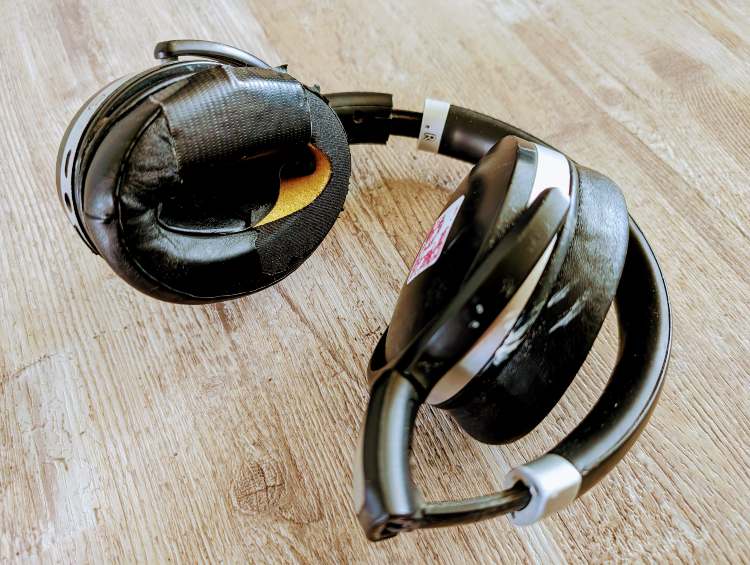
One annoying aspect of this device is that it’s difficult to tell whether they are on or off. There is not indicator to tell you whether the power is on and the noise canceling doesn’t always work well enough to tell. To power them on or off, you hold down a button for a couple of seconds. The headphones say “power on” or “power off” to alert you to their state.
In my sprint through life, I often forget whether I’ve turned them on or off. So, I’ll go to turn them off and then realize they were already off and are now on. Super annoying.
Last week, this happened a couple of times and the thought I had was this:
Why don’t you just slow down a little bit and be mindful of what you’re doing?
Deoptimization
We live in a culture obsessed with optimization. Tim Ferriss has made a career telling us how we can cram large tasks into mere hours (The 4 Hour Workweek, The 4 Hour Body). We drive fast to get to our next thing. We listen to podcasts at 2x. We get meals shipped to us so we don’t have to cook. Or just have a service bring food to our doorstepm
Move faster and faster. Get more done with less time. Yee haa!!!
And then BOOM, another year has slipped away. Where did it go?
Frugality and optimization are similar in that they serve us well during some phases in our life, but then we turn a corner and they no longer provide value.
Both are great skills when we’re money and time poor. Be frugal so you can sock dollars away and get the money snowball compounding. Figure out ways to optimize so you can ramp up our skills quickly and make more money.
And with some hard work, time and a little luck, you may find yourself in a great place where you have Enough.
While I’ll never waste money and always embrace parts of frugality, it doesn’t make sense to spend time hunting coupons or deals.
And optimization is a bigger issue. The question we should always be asking ourselves is this:
What am I optimizing for?
And maybe this:
Why am I still optimizing?
When I was new to my job, being ultra-productive meant advancing in my career and earning more money. When I worked on houses, it meant being able to get the work done quicker. But now, I don’t work and the home projects are almost done. I want to move a little slower.
- It’s nice just to take walks. On the walks, I look for interesting plants and insects to photograph. Sometimes I’ll check out a new band on my headphones.
- It’s nice to engage my teenage daughters in long conversations.
- It’s nice to sit down and write. (So meta!) Just like the walks, sometimes I don’t have a destination in mind, but that’s OK.
The older I get, the more I realize that changing with and adapting to the changing phases and seasons of life one of the keys to successful living. But it goes deeper than that. To do this, you have to be open to new ideas and not get stuck in your ways. The longer you stay in a rut, the deeper it gets and the harder it is to get out of it. Or maybe even realize that you’re in it.
The Way Forward
Can mindfulness and productivity be reconciled? Probably. But I believe that it’s a delicate balance. You can’t focus so much on optimizing everything that you forget to live. Can one optimize for not optimizing? 🙂
More 1500 Days!!!
You can also find me (and the dinosaurs) at:
Mile High FI podcast:
MindyOnMoney podcast! New project with Mindy.
Also here:
- Facebook: Facebook group and page
- YouTube: My channel is mostly devoted to home improvement, but I have some other material coming up soon too.
- Instagram: Pretty pictures of dinosaurs, sunsets, and nail guns!
- Twitter: Spontaneous, often insane, ramblings
- Coworking space: On the surface, MMM HQ is a coworking space. Look a little deeper and you’ll see that we’re really building community. The members of MMM HQ are some of the finest people I know
- Buying a Tesla? Use my referral code to get some perks!
I like your new direction. It is more appropriate for your current (and recent years) financial condition.
I hope you learn to enjoy the lifestyle you have literally earned.
I suspect that this new direction is not going to help you maintain or increase readership. Continuously seeing and hearing about the lifestyle that you have and most of your readers aspire to won’t wear well. It inevitably gets looked at as boasting, irrelevant, or just tiresome. Watching your 1500 day ‘race’ was interesting and entertaining. Any lengthy victory lap is neither.
If I’m right, please don’t change the direction of your life. Celebrate and enjoy your success. And pivot to a different theme and audience.
Hi Bob!
Interesting thoughts.
Yeah, posting how great is Instagram style wouldn’t make for great content, but it’s something I don’t think I’d ever want to do either. The other point is that I’ve experimented with spending money and most of the stuff just doesn’t make me happy. I like to write, take walks, and exercise. When I travel, the most important thing about the hotel isn’t the accommodations, but the location. Being in a walkable area with interesting stuff to walk to is far more important than being pampered in a spa.
One of the best things we learned to spend money on this year was a house cleaner. It sounds ridiculous, but outsourcing this tasks gives us precious hours back in our lives that we can now spend something we enjoy.
I really dig your thoughts and your transition. As someone in a similar financial fortress, I can deeply relate to this development. And I bet that in the meantime, there are enough FIRE aspirants that discover the same luxury problems. And those who aren’t in this phase yet, can still profit from your hindsight.
Overcoming frugality when you have reached the state of enough is hard. Life long habits sit deep. But it totally makes sense to focus on happiness & life itself and stop caring about minor expenses. The bigger the portfolio, the bigger the minor expenses can get without feeling bad about them. But to me, it’s really hard to really enjoy certain expenses – deep in my core some nagging voice is still there, questioning every unnecessary luxury expense. I’m not talking about yachts! But it’s slowly getting more adequate.
Patrick, thanks for the kind words.
“But to me, it’s really hard to really enjoy certain expenses – deep in my core some nagging voice is still there, questioning every unnecessary luxury expense. I’m not talking about yachts! But it’s slowly getting more adequate.”
The other thing I’d add is that I can’t think of much that I could buy that would make me happier or make life easier. I have a great house with great neighbors, so have no desire to move. I bought a Tesla and that’s great, so no upgrade there either.
As a kid, I lusted after crazy cars (shout out to the Countach), but now that I can have just about any car I want, I no longer want it.
Looking back what optimization was worth it and what wasn’t? Which ones do you think you will still do going forward?
I know looking back in my life some of the things I regret the most are things missed out on. The kids are only young once, and grow up so fast. When you are rushing to drop them off at day care, putting in a full days work and rushing to pick them up, make dinner, clean up it’s hard to enjoy that precious time. Quality time with family and friends is one thing I would never regret.
Kids: Yeah, I wish I would have been more present when mine were younger. You can always get busy again once they get back to school.
Optimizations: I’m not sure if this is an optimization, but learning trades like plumbing, electricity, and framing has put us ahead by leaps and bounds. My projects are almost done, but there is something always breaking and now I have the confidence to fix them. Hiring stuff out always seemed to lead to disappointment and frustration.
One other one is just driving old cars. Before this year, our cars were from 2003 and 2010. No payment and cheap insurance. Investing the money that would have otherwise went to car expenses is huge.
I like watching your transition, as well as MMM, Mad Fientist, and others as you get to the destination and realize that maybe there are bigger priorities than money.
And as a twenty something in the accumulation phase, your transition to happiness and life philosophy, is incredibly informative and forces good reflection now to try to learn from what you would change in your life now and maybe try to find the right time for me to do that to not wish I had done it sooner.
Hearing you on I will teach you to be rich recently helped drive that home and I think you and the others transitioning to philosophical musings primed me to be receptive to a new mind set. I am reading I will teach you to be rich for the second time and I can tell I am a different person than when I read it the first time 4-6 years ago and it hits me different.
Thanks for sharing your perspectives and I’ll keep reading along and learning and celebrating your wins and learnings.
Alec-
Thanks for reading and for the kind comment!
I wish I would have realized that money wasn’t the ultimate priority earlier. While important, it’s just a tool to make life easier and happier. No reason to postpone those, especially the latter, until you reach some Big Number.
“Why are you still optimizing?” That one hit home for me, for sure!
Separately: is there an email where you can be reached? I pitched a guest post using the email on your Contact page, but it bounced back.
Got your email. I’ll reply shortly.
You get wiser by the day, Carl! Even after achieving FI I was impressed at how you did so much work doing renovations, a podcast, and staying active in many parts of life. I agree, sometimes taking it slow and practicing gratitude at how far you’ve come is a good thing. You tend to appreciate life more, and remember small encounters that bring joy. Not everyone has that luxury. It’s ok to optimize a bit, like placing your keys in the same place, but I’d go crazy if I ate the same foods or hunted for coupons!
I just finished re-reading The 4 Hour Work Week over the weekend. And while the core premise of the book is how to optimize your business to be as streamlined as possible, reading it again I found that Tim really does take a lot of time in the book asking you to focus on why you are optimising everything.
When I first read it I think my main takeaway was on the optimization front, and I’ve definitely done a lot of that with how I handle my day job and investing. Re-reading the book I’m definitely at a different stage in my life. Not completely financially independent, but well on my way to reaching it. I need to take some time to experiment and figure out more of what I want to do, and focus on learning to use money as a tool to do those things and not as a means to an end in itself.
It’s been interesting to follow you and others as they are trying to work out the same problem. Hopefully it gets easier with time.
Excellent
I can relate to this. I’m thinking at these exact things currently. Less routine and trying things. Stop being such in a hurry all the time, living in the moment. Good luck with that I think you are well on your way!