
Hello out there! It’s been a while since I fired up the keyboard. Summer is here and I’ve been busy with the family moving about the country:
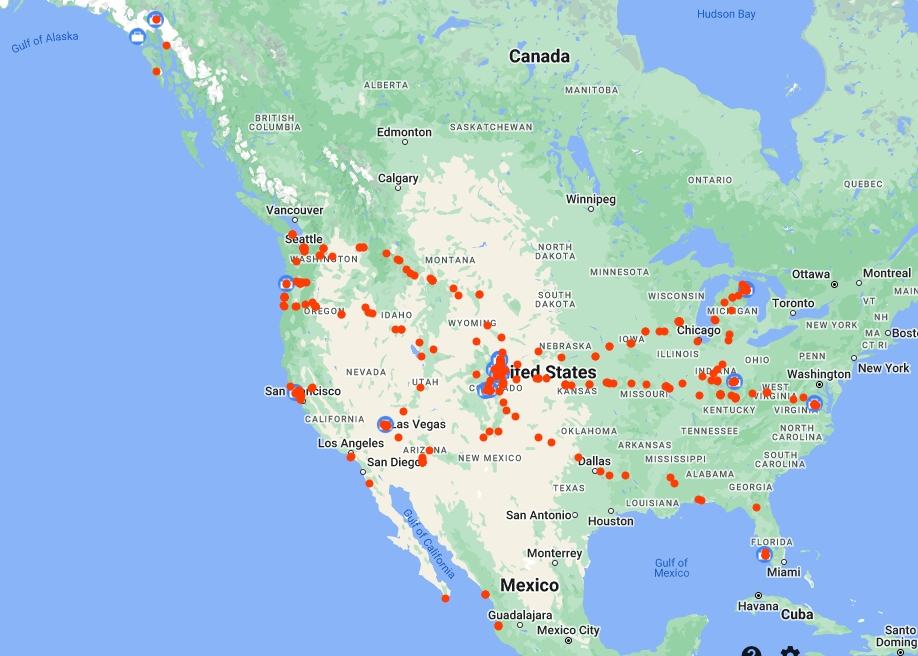
And it’s not over yet.
- In September, I head to New Jersey to visit my good friend Bob.
- Bob and I then head to Stuttgart with a group of friends for Volksfest.
- From Germany, I’ll fly to Cancun to attend BPCon.
Phew.
After that, we’re going to stick around home for a while. Travel is fun, but Colorado ain’t bad either. 2025 is the year where we’ll mostly stick around the Hexahectaenneacontakaiheptagonal State!
Two Incredible (And Humbling) Index Investing Truths
Most of us in the FIRE community are big fans of index funds. I like to understand things deeply, especially when my financial future depends on it. Life would be so much simpler if I just trusted JL Collins and Jack Bogle, but I like to know how stuff works. Silly me.
In any case, I was reading about index funds lately and stumbled across two interesting (to me anyway) facts:
1. The Overwhelming Number Of Companies In An Index Fund Are Big Losers
Check this out (hat tip to Ben Carlson):
…four out of every seven stocks in the U.S. have underperformed cash (one-month T-bills) since 1926. And just 4% of companies accounted for all the wealth gains for the entire stock market in that time.
And this:
The average cumulative return going back to 1926 was nearly 23,000%, just a gargantuan number. But the median stock in that time experienced a cumulative return of 7.4%.
So, you’re buying thousands of stocks just to catch the few Apples or Googles.
2. Very Few Days In The Market Count
What if you missed the 10 best days in the market?
Looking at data going back to 1930, Bank of America found that if an investor missed the S&P 500′s 10 best days in each decade, total returns would be just 91%, significantly below the 14,962% return for investors who held steady through the downturns.
– Pippa Stevens via CNBC
To summarize these two thoughts:
- You buy an index fund to catch the very few companies that severely outperform. The overwhelming majority are losers.
- You hold an index fund to catch the few days that outperform. Don’t be naughty and try to time the markets.
It’s very hard to pick the handful of companies that will be the big winners. It’s even harder to pick the days where you should jump in (or out of) the markets.
So, you should just buy VTSAX, ignore the noise, and hold it forever. Just as JL Collins and Jack Bogle have always advised.
I’ll leave you with a photo from our travels. This cool gold Farmall toy tractor was on display at the National Farm Toy Museum in Dyersville Iowa:

More 1500 Days!!!
You can also find me (and the dinosaurs) at:
Mile High FI podcast:
MindyOnMoney podcast!
Also here:
- Facebook: Facebook group and page
- YouTube: My channel is mostly devoted to home improvement, but I have some other material coming up soon too.
- Instagram: Pretty pictures of dinosaurs, sunsets, and nail guns!
- Twitter: Spontaneous, often insane, ramblings
- Coworking space: On the surface, MMM HQ is a coworking space. Look a little deeper and you’ll see that we’re really building community. The members of MMM HQ are some of the finest people I know.
How much of this travel was in the Model Y? I also have a Model Y and kind of like it on long trips. The forced pauses are great. I usually have my dog so we both get to stretch our legs. Those look like pretty long trips though.
We did two trips in the Y:
1) Longmont to Seattle to Portland and back to Longmont (~4,000 miles).
2) Longmont to Bloomington (IN), to Louisville (KY), to northern Michigan and back to Longmont (~3,000 miles).
I too like traveling in the Y. It takes some planning, but overall, it’s more relaxing.
Most people don’t really know what the S&P 500 index really is. It really is a ‘virtual’ mutual fund that others have turned into real mutual funds. And like all mutual funds, this ‘fund’ is actively managed.
This index fund has a success bias. It regularly drops the worst performers and adds to the list new companies that are fast growing. There is some nuance like sector bias and float weighting but the companies in the S&P 500 can be deselected despite continued existence and size comparable to companies added. And companies added are not necessarily the next in line based on capitalization. There is no set formula. And there can’t be because if there was, traders could front run the adds and deletes. The 4% of companies in the S&P 500 that account for the growth are not 4% of companies from 1926.
According to statista.com, from a 2020 report, the average lifespan of a company on Standard and Poor’s 500 Index was just over 21 years, compared with 32 years in 1965. There is a clear long-term trend of declining corporate longevity with regards to companies on the S&P 500 Index, with this expected to fall even further throughout the 2020s.
While the S&P 500 will always have a range of performance for individual companies, the bias of this index is successful companies that are likely to continue to grow. Over time, this index will outperform and index of the actual top 500 by market capitalization.
And for people who are not inclined or able to be active investors, the S&P 500 index is a good way to grow as the USA economy grows.
This link shows that the S&P 500 and the DJ30 have about the same performance over the last 50 years:
https://www.stlouistrust.com/insights/head-to-head-dow-vs-sp-500-and-the-shocking-results/
A trader, like me, might find it easier to ‘personalize’ an index (like dropping perceived long term losers) using the Dow rather than the S&P. Sophisticated (complex) strategies are easier because the volumes for options and the general liquidity for the Dow 30.
======
Nothing really important here, just a long winded way of saying the S&P might not be as ‘bad’ as you might think.
I have been reading your blog for a long time and really appreciate your journey, your transparency and thoughts. I have missed your lack of posting over the summer, but glad you are enjoying some more free time not working on a house. I had a question that I am just trying to understand, you have said for a long time to put money in VTSAX and it’s the easy button, but it doesn’t seem like you have done that. Right now, it’s not even 10% of your assets. Am I missing something between what you are saying and doing? Personally, I am up to 54% of my assets in VTSAX (or FZROX – Fidelity version with no fees) and have appreciated the ride up!
Hi Chris!
Thanks for the kind words! I’ll be back to posting more shortly.
Why not more VTSAX?: There are a five main reasons:
1) I took money out of VTSAX for private lending. The current balances of those two loans is $658,000. I make a pretty safe 12% off these loans, so I’m happy to give up VTSAX returns for them.
2) Mindy and I share a Vanguard pooled account for our solo 401(k). To make accounting easier (keep our money separate), I put all of her money in VFIAX (current balance of that is $540,000) which should have a very similar return to VTSAX.
3) I picked stocks before I knew what an index fund was. I’m slowly moving out of these in favor of funds, but it will take a while (capital gains!).
4) I couldn’t help investing in SpaceX (it’s my pre-IPO company in my chart). It has an incredible moat, so I took $250,000 out of VTSAX and invested in that.
5) I still have a tech bias, so that’s why you see some money in QQQ, VGT, and FTEC.
Over time, my balances in VTSAX and VFIAX should grow more than everything else. I’m slowing selling off my stocks and moving to the funds. Syndication deal proceeds will also go into them as will my private loans.
How is it possible for a non employee to buy SpaceX stock. Please share privately if you can’t disclose on this blog. The company is private. I suspect others would love the opportunity to safely buy and later sell. The closest competitor is Rocketlabs RKLB I think and they are likely nowhere near the size, Kind of fun and rewarding to have a portfolio of individual stocks too which I think you will still stick with given your success in doing so and it’s okay to say so even though the FIRE community may disagree.
You can either buy from employees or on the secondary market. I am the latter. It was a real pain to find and to figure it all out, but I think it will be worth it. Starlink has a lot of momentum and I believe it will IPO before the decade is out.
I’ll see if I can share who I went with and email you directly if I get permission.
I’m surprised at how packed airports are in the summer, even in the middle of the week. Your travels sound fun, Carl! And just saw a chart on missing the 10 best days in the market, big sticking point.
You mean cumulative return of 7.4% right, not -7.4%? Why is the negative symbol in front?
Whoops! Fixed and thank you!
That’s ok you don’t have to do that work. I hope that trade works out like Tesla. Now I think I have to get some Hostess Meltaways advertised on your blog. They look good. lol.
We had our retirement plan admin in to talk about volatility today. He had some great graphics to show similar results of being out of the market on the best days. Great evidence to support a buy and hold strategy. Love it.